You are not just buying a Westport waterfront address. You are buying a set of rules, approvals, flood risks, and boating access rights that can shape how you use the property for years to come. If you want a home that works as beautifully on paper as it does in person, it helps to understand what sits behind the view. Let’s dive in.
Why Westport waterfront buying is different
In Westport, a waterfront purchase often involves more than the house itself. State coastal rules, town wetland regulations, floodplain standards, and local shoreline oversight can all affect what you can keep, change, or build.
That means two homes with similar frontage can offer very different long-term value. One may have straightforward access, cleaner permit history, and fewer hurdles for future updates, while the other may require multiple layers of review before any work can begin.
Understand the regulatory layers
Connecticut DEEP regulates work in tidal, coastal, and navigable waters. That includes docks, pilings, floats, ramps, jetties, seawalls, bulkheads, dredging, decks, and similar shoreline improvements.
Westport adds its own review in several areas. The town regulates inland wetlands, watercourses, and waterway protection lines, and it also has a Flood and Erosion Control Board that addresses flood and erosion concerns.
For you as a buyer, the key takeaway is simple. A waterfront improvement can trigger both state and town review, so it is important to understand which approvals already exist and which ones may still be needed.
Docks are not automatic
One of the biggest misconceptions in waterfront buying is that water frontage automatically means dock rights. In Westport and coastal Connecticut, that is not the case.
DEEP states that waterward of mean high water is public trust territory. Upland owners generally own land landward of mean high water, and a littoral property owner typically has one point of access per parcel.
That may sound straightforward, but the real-world result is more nuanced. A property can touch the water and still face limits on whether a dock can be added, replaced, or expanded.
What DEEP generally allows
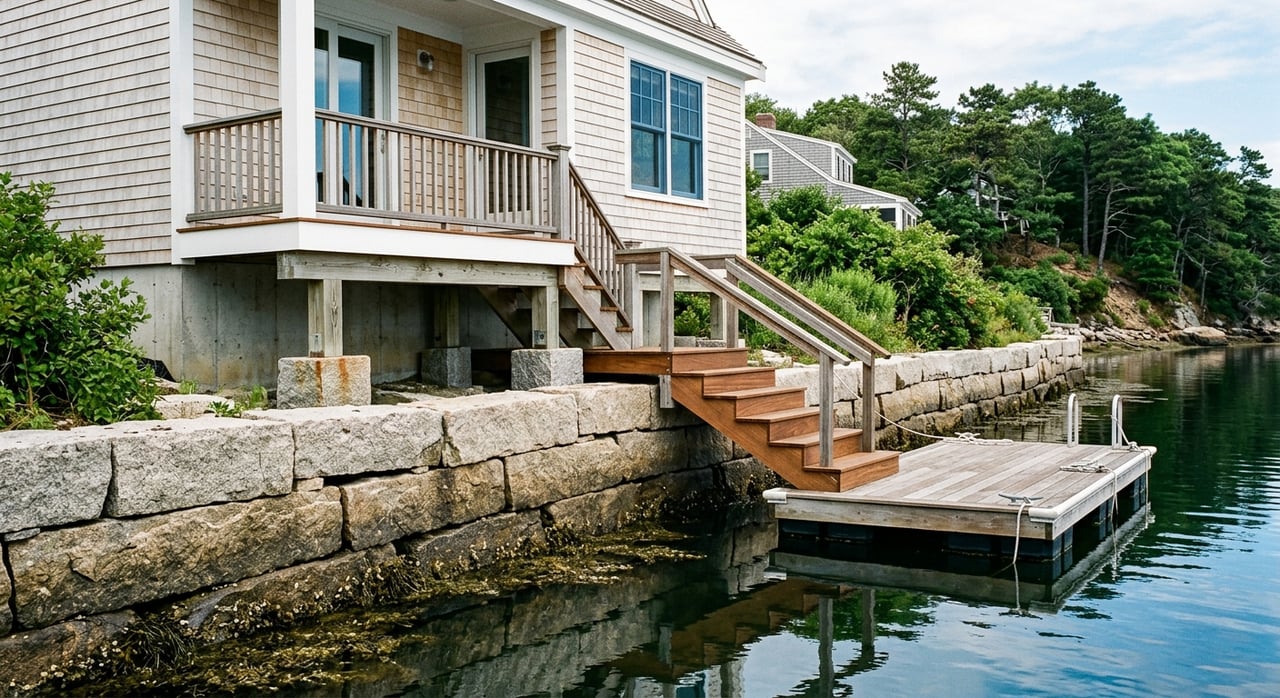
Under Connecticut DEEP guidance, a commonly acceptable residential dock is:
- A four-foot fixed pier extending to mean low water
- A gangway or ramp
- A 100-square-foot float
Under the residential general permit, docks may be no larger than 220 square feet waterward of mean high water. They are also limited to sites without tidal wetlands or submerged aquatic vegetation.
Why a private dock may still be difficult
Even if a dock seems physically possible, the site may not qualify for a routine approval. DEEP notes that structures not necessary for boating access, such as gazebos or similar features, are generally not permittable waterward of the coastal jurisdiction line.
It is also important to know that docks on easements do not usually create new littoral rights. Shared dock arrangements can be larger only when owners legally relinquish individual littoral rights.
Dredging is a major issue
If you are considering a property that would need dredging to make boating practical, do not treat that as a small follow-up project. DEEP says new dredging is strongly discouraged, tidal wetland and intertidal dredging is not allowed, and maintenance dredging is limited to previously authorized areas.
In plain terms, if adequate water depth is not already there, solving that problem may be difficult or impossible. That can materially affect how useful the property is for boating.
Moorings matter in Westport
For some buyers, an approved mooring can be just as important as a dock. Moorings are regulated too, and in Westport the town directs owners to the Harbor Master for mooring opportunities within state waters.
DEEP says moorings authorized by a Harbor Master can qualify for a general permit. Otherwise, they must be approved through the appropriate state review process.
There are also clear placement limits. Moorings cannot be placed in federal navigation channels, tidal wetlands, or over submerged aquatic vegetation.
Why this matters for your lifestyle
Westport maintains two marinas and launch sites, but in-water slip assignments are resident-only and subject to a wait list. If you want regular boating access, a property with an existing approved dock or mooring can have a real practical advantage.
That is why boating access should be treated as part of the home’s utility, not just a lifestyle bonus. Existing approvals can make the property easier to enjoy from day one.
Flood zones can change the buying equation
Flood zone status is one of the most important facts to verify before you buy. FEMA defines Special Flood Hazard Areas as the 1-percent annual chance floodplain, often called the base flood or 100-year floodplain.
Westport zoning adopts these areas on FEMA flood maps, including Zones A, AE, and VE, as well as floodway areas. Those labels matter because they can affect construction rules, renovation flexibility, and insurance requirements.
AE vs. VE in Westport
In Westport Zone AE, new residential construction and substantial improvements must have the lowest floor at or above base flood level. In Zone VE, the rules are stricter.
For new construction and substantial improvements in Zone VE, structures must be landward of the Connecticut Coastal Jurisdiction Line, use elevated pile or column-style foundations, and cannot rely on fill for structural support. FEMA also describes Zone VE as a coastal high-hazard area with wave-action risk.
Why neighboring homes can differ
Westport notes that base flood elevation data on FIRMs are approximate and should be checked against the Flood Insurance Study for the exact location. That means one home can have a different flood profile than the house next door.
For buyers, that can lead to different renovation costs, different design limits, and sometimes different insurance outcomes. It is a reminder not to make assumptions based on nearby properties alone.
Flood insurance is separate from homeowners insurance
Many buyers are surprised to learn that flood insurance is not part of a standard homeowners policy. It is a separate coverage decision, and in many cases it is also a lender requirement.
FEMA says flood insurance is required for many government-backed mortgages in Special Flood Hazard Areas. FEMA also notes that NFIP policies usually have a 30-day waiting period unless the policy is tied to a lender requirement or a map change.
Connecticut DEEP notes that flood insurance can be purchased both in and out of the Special Flood Hazard Area. That matters because even lower-risk areas can still experience flood losses.
Map changes are worth watching
Westport says FEMA flood map changes are anticipated for fall 2026 and directs property owners to current and preliminary mapping resources. FEMA also allows owners who believe they were incorrectly mapped to pursue a Letter of Map Change.
If you are buying now, current mapping should be reviewed carefully, but it is also wise to understand whether preliminary changes could affect the property later.
Renovations near the water often need extra review
A waterfront home may look ideal today, but future plans matter too. If you want to add a deck, renovate lower levels, build an addition, replace shoreline structures, or regrade the site, local review areas can become very important.
Westport’s Waterway Protection Lines are set at the 25-year-storm flood elevation, with an added 15 feet on several named waterways, including the Saugatuck River. The town regulates filling, dumping, and permanent structures within those lines, and non-permitted activities generally require Flood & Erosion Control Board and Conservation Commission approval.
Wetland setbacks can affect design plans
Westport’s inland wetlands rules add another layer of review. Setbacks are measured from the wetland boundary or top of bank, whichever is greater.
The town provides examples that include:
- 50 feet for single-family homes and additions
- 75 feet for larger nonresidential or multi-family structures
- 30 feet for decks, patios, walls, and some site features
- 20 feet for certain fill or grading
These distances can significantly shape what is feasible on a lot. A project that seems modest in concept may still need detailed review if it falls within a regulated area.
Building permits still apply
Even when coastal or wetland review is part of the picture, ordinary building permits may still be required. Westport states that permits are required for new construction, major repairs, renovations, additions, decks, porches, and demolitions.
The town also notes that a wetland-regulated project cannot begin until required zoning or subdivision approvals are in place. In other words, sequencing matters, and permit timing can affect your renovation schedule.
What smart buyers should verify
Before you commit to a Westport waterfront property, it is worth reviewing a few key items closely. This can help you understand not only what the property is today, but also how easy it may be to finance, insure, improve, and enjoy.
A strong due diligence list includes:
- The current FEMA map panel and flood zone
- Any available elevation certificate
- Existing dock approvals and permit history
- Mooring approvals or Harbor Master status, if relevant
- Any seawall, bulkhead, or dredging history
- Whether planned additions, decks, grading, or shoreline work fall within Westport coastal, wetland, or floodplain review areas
In many cases, the best waterfront homes are not just the ones with the best views. They are the ones with existing water access, stronger elevation profile, and a cleaner path for future ownership decisions.
Why permit history affects value
For luxury buyers in Westport, paperwork is not separate from lifestyle. Permit history, flood elevation, and approved access are part of what you are buying.
A home with an existing permitted dock or approved mooring may be easier to use immediately. A home with higher finished-floor elevation or fewer shoreline complications may also be easier to insure or modify over time.
That is one reason experienced local guidance matters so much in this segment of the market. The right waterfront home should support both your day-to-day enjoyment and your long-term flexibility.
If you are weighing a Westport waterfront purchase, having an expert eye on flood exposure, dock history, and future improvement potential can make the process far more strategic. For tailored guidance on Westport’s coastal luxury market, connect with Jackie Davis.
FAQs
What should you check before buying a Westport waterfront home?
- Verify the current flood zone, review any elevation certificate, confirm dock or mooring approvals, and check whether planned changes could trigger local or state waterfront review.
Can any Westport waterfront property have a private dock?
- No. Dock approval depends on state coastal rules, site conditions, and whether the property can meet permitting requirements.
What is the difference between AE and VE flood zones in Westport?
- Zone AE generally requires the lowest floor of new residential construction or substantial improvements to be at or above base flood level, while Zone VE has added coastal high-hazard standards, including elevated pile or column foundations.
Do Westport waterfront buyers need separate flood insurance?
- Yes. Flood insurance is separate from standard homeowners insurance, and it may be required by a lender for properties in Special Flood Hazard Areas.
Why does permit history matter for a Westport waterfront property?
- Existing permits and approvals can affect how easily you can use the property, insure it, finance it, or make future changes such as adding shoreline structures or renovating near regulated areas.